Why On-Demand Staffing is Replacing Traditional Hiring in 2026
1. Introduction: The Death of the 30-Day Time-to-Hire
The corporate recruiting landscape in 2026 has crossed a critical threshold. The conventional recruitment lifecycle—characterized by multi-week job postings, exhaustive resume screening, sequential interviewing, and prolonged onboarding protocols—has completely broken down under the pressure of dynamic macroeconomic fluctuations. For highly volatile sectors such as hospitality, catering, event execution, and hotel logistics, relying on an obsolete 30-day time-to-hire metric is no longer a sustainable business practice. It represents an active threat to revenue retention and customer experience consistency.
Forward-thinking enterprises are systematically restructuring their operations around alternative flexible workforce models. By transitioning from fixed organizational frameworks to agile, just-in-time capacity systems, leaders are ensuring that shifts are seamlessly covered without maintaining heavy full-time headcount. As a premier nationwide agency, First Class Workforce Solutions sits at the direct epicenter of this operational revolution, engineered to arm businesses with instantaneous workforce scalability.
Need instant access to pre-vetted culinary, hospitality, or housekeeping professionals?
➔ Explore Tailored Staffing Solutions Now
2. The Economic Catalyst: Structural Overhead vs. Dynamic Labor Budgets
From a strict corporate finance perspective, traditional employment structures impose massive secondary financial allocations that drain operational margins. Beyond baseline wages, employers bear heavy structural overhead: State Unemployment Insurance (SUI) adjustments, Federal Unemployment Tax Act (FUTA) obligations, comprehensive workers’ compensation premiums, comprehensive employee health benefit provisions, and onboarding administration friction. When attrition rates rise, the capital loss associated with sourcing, vetting, and retraining repetitive staff positions escalates exponentially.
Conversely, an engineered on-demand staffing infrastructure transitions labor allocations entirely from rigid, fixed expenditures into highly responsive, variable operational budgets. Businesses pay strictly for active hours delivered by productive assets, while the primary administrative burden, liability management, background vetting, and payroll operations remain localized within the partner agency.
This financial architecture mitigates long-term liabilities while simultaneously improving net margin metrics.
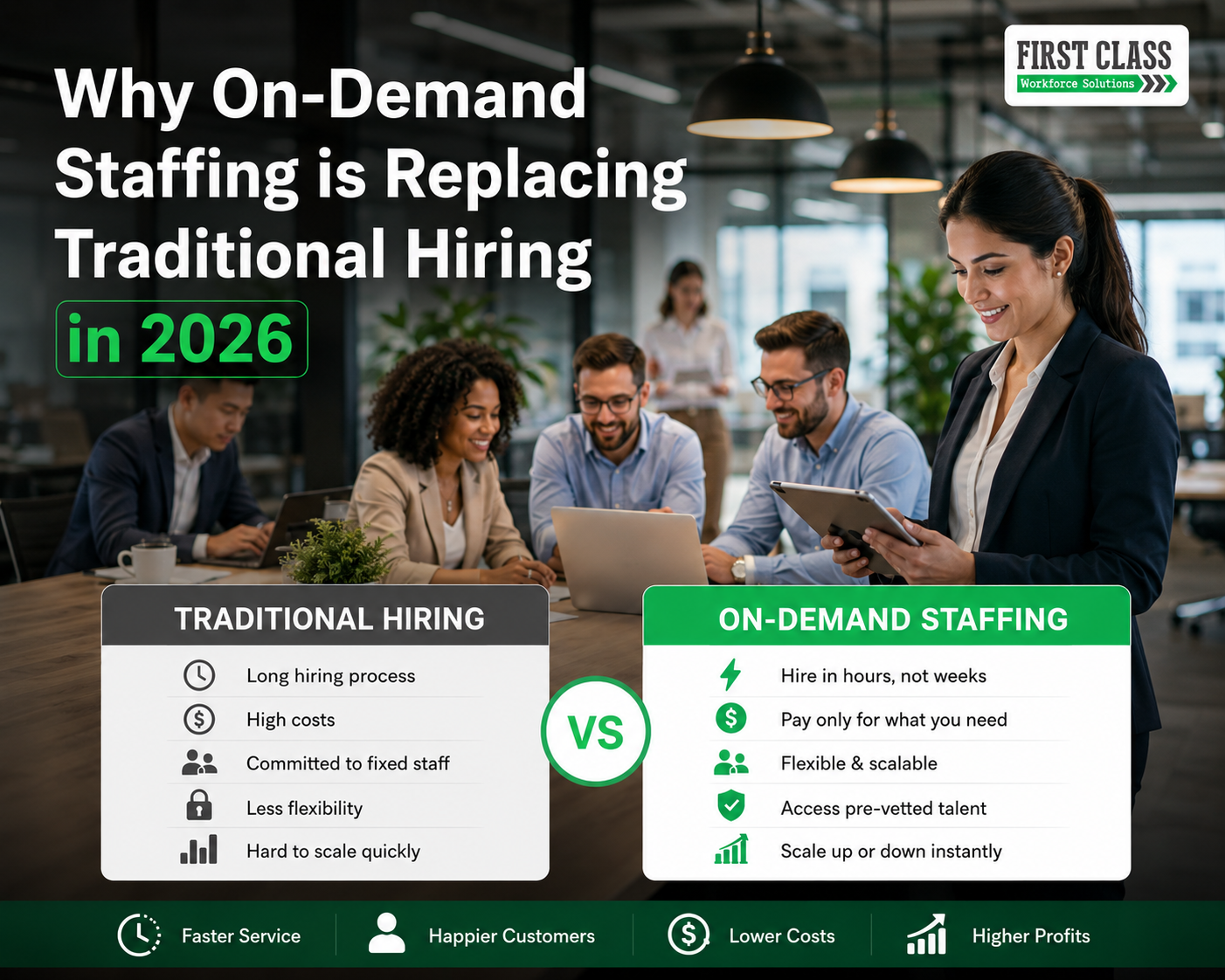
Comparative Architecture Matrix: Traditional vs. On-Demand Systems
| Hiring & Operational Metric | Traditional Recruitment Model | On-Demand Staffing Solution (2026) |
| Average Fulfillment Velocity | 21 to 45 Calendar Days per placement | Same-day / Next-day localized deployment |
| Overhead and Regulatory Burden | SUI, FUTA, Workers’ Comp, Benefits Admin | Consolidated single-invoice variable billing |
| Scalability Elasticity | Extremely rigid; costly termination liabilities | Real-time scaling matching real-time demand |
| Vetting & Compliance Risks | Internalized risk; lengthy background loops | Pre-screened, specialized, instant deployment |
3. Operational Agility: Navigating Demand Volatility in Hospitality and Food Service
Hospitality management, event execution, and food service logistics operate in a high-velocity environment where customer demand fluctuates based on micro-variables: seasonal tourism shifts, corporate event bookings, holiday spikes, or immediate weather disruptions. Attempting to balance a fixed full-time roster against these volatile demand patterns inevitably leads to two costly operational failures: over-staffing during low-demand periods (which directly de-optimizes payroll margins) or under-staffing during peak events (which compromises operational output and degrades customer retention rates).
To secure an unfair competitive advantage, enterprise managers deploy specialized temporary staffing services to absorb external operational shocks. Whether an organization requires structured banquet captains for immediate corporate functions, a dynamic line-cook roster for sudden convention traffic, or comprehensive housekeeping teams to sustain rigid hotel brand metrics during peak vacation cycles, on-demand staffing platforms ensure that production capabilities exactly mirror actual consumer demand curves.
Is demand volatility squeezing your operating margins? Tap into a flexible, scalable workforce today.
➔ Connect with a Local Staffing Expert
4. How Tech-Driven Vetting and the FCW App Risk-Mitigate Gig Placements
Historically, the primary operational objection to rapid-deployment staffing models focused heavily on talent quality control and localized compliance integrity. Executives worried that rapid-fill personnel might lack the precise culinary certifications, grooming standards, or background verifications required by top-tier global hospitality standards. However, in 2026, technology has completely neutralized these quality-control concerns.
Through specialized proprietary infrastructure like the First Class Workforce App, the entire workforce logistics lifecycle is digitally optimized. Every associate inside the network undergoes a rigorous screening protocol, including comprehensive background checks, verifiable reference tracking, and skills assessment criteria before ever accepting a shift. For employers, the mobile app delivers unparalleled operational visibility: real-time job order tracking, automated electronic clock-in/out synchronization, transparent schedule management, and instant digital timesheet approvals. This tech-forward infrastructure eliminates administrative friction while ensuring elite compliance and reliability across every single placement.
5. FAQs
Question: Why is traditional hiring no longer viable for hospitality and food service in 2026?
Answer: Traditional hiring models are fundamentally built on static, long-term projections that fail to match the modern velocity of demand volatility. High administrative overhead, rising regulatory compliance liabilities, and an average 30-day time-to-hire window make manual recruiting too slow and financially risky. On-demand staffing platforms eliminate these friction points by maintaining a pre-screened pool of specialized workers ready for rapid deployment, turning labor into an elastic variable expense.
Question: How do on-demand staffing solutions reduce labor overhead costs for enterprises?
Answer: On-demand staffing models significantly reduce corporate overhead by transferring all secondary payroll liabilities—including State Unemployment Insurance (SUI), Federal Unemployment Tax Act (FUTA) costs, workers’ compensation premiums, onboarding overhead, and benefits administration—directly to the partner staffing agency. Enterprises pay exclusively for productive, billable hours worked, completely eliminating the sunk capital losses associated with employee attrition and idle, un-utilized labor capacity.
Question: What metrics ensure the quality and compliance of on-demand hospitality workers?
Answer: Quality assurance in modern on-demand models is driven by advanced technology integration and comprehensive vetting protocols. Platforms like First Class Workforce Solutions enforce multi-tiered screening loops: localized criminal background verifications, past reference audits, and precise culinary/service certifications. This is coupled with real-time performance tracking via mobile applications to guarantee that strict brand guidelines, professional grooming standards, and operational competencies are consistently upheld across every single shift.
Question: How does the First Class Workforce App simplify talent management for hiring managers?
Answer: The proprietary mobile app eliminates manual administrative tracking by digitizing the entire shift-management pipeline. Hiring managers can seamlessly place job orders, monitor real-time worker deployment status, track attendance via precise electronic clock-in/out functionality, and instantly review or approve automated digital timesheets, severely reducing the strain on internalized HR departments.
6. Conclusion: Future-Proofing Your Business Architecture
The transition from outdated traditional recruitment structures to dynamic on-demand labor fulfillment is not merely a temporary market trend; it is a permanent paradigm shift in corporate operations. In 2026, organizational resilience is entirely dependent on flexibility. By partnering with an elite agency specializing in hospitality, food service, and culinary logistics, your business can insulate its margins from unexpected macroeconomic pressures while ensuring consistent, world-class operational output.
Ready to transform your labor architecture and future-proof your logistics model? Discover how First Class Workforce Solutions can optimize your operation across our extensive network of corporate offices and local markets. If you are a business executive aiming to deploy optimized, agile capital, immediately explore our comprehensive temporary staffing services. Alternatively, if you are a skilled culinary or hospitality professional looking to gain control over your schedule and maximize your earnings, visit our portal to find a job near you and access our seamless, user-friendly how to apply portal to launch your career today.